
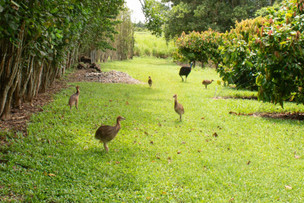
Rainforest Jackpot: Super Dad and 5 Stripeys at Charley’s
Posted by Ruth Medd on 9th Feb 2026
Cassowaries at Mission Beach – copyright January 2026
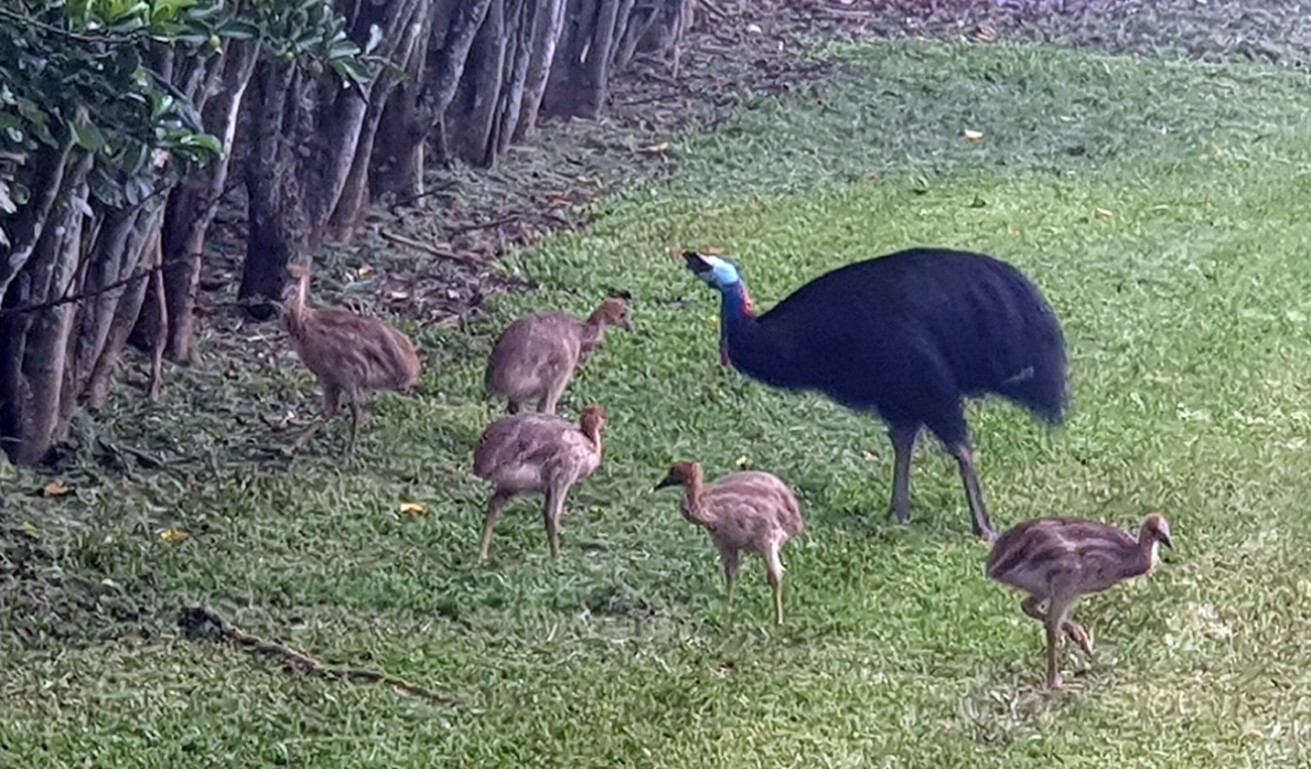
Dad with 5 healthy chicks (0 to 3 months) – the fab five is a statistical miracle
Finding a male cassowary with five chicks is the "Rainforest Jackpot"
There’s nothing quite like the thrill of spotting a male cassowary with five striped chicks on our Mission Beach property. Tour guides call it the Rainforest Jackpot, and for good reason.
Charley’s commitment to sustainability and conservation delivers
for this magnificent super dad and his stripeys who feast daily on the delights of our 81 ha of lowland tropical rainforest and the luscious fruit from our Kwai Muk trees, planted as wind break for our cocoa plantation.
All about cassowaries
Mission Beach is a hub for cassowaries. Despite this, only one five-chick sighting has been recorded at Mission Beach since 2015. Cassowaries are integral to the identity of Mission Beach. As the "Gardener of the Rainforest", the seed dispersing activity of the cassowary preserves our rainforests.
Against All Odds
While female cassowaries typically lay between three and five large, pea-green eggs, it’s extraordinarily rare for all five to hatch and survive. The odds are brutal: feral pigs, dogs, and even pythons (yes, Peter the Python is resident at Charley’s!) threaten the stripeys when they’re small. Add the danger of road crossings along the El Arish-Mission Beach Road, and statistically, only about one in nine chicks survives to adulthood.
Seeing five stripeys together means Dad is an absolute elite bodyguard. Only one five-chick sighting has been recorded at Mission Beach since 2015, when a local captured grainy but incredible footage of a male cassowary sauntering through South Mission Beach with his full brood in tow.
Super Dads, Wandering Mums
In a fascinating role reversal, after laying her eggs, the female cassowary leaves. Zero parental care. The male takes on all domestic duties: 50 days of incubating eggs, protecting chicks, teaching them about the best fruit sources, and training the next generation of gardeners of the rainforest.
Meanwhile, Mum is off to find another partner. The female cassowary is the more vibrantly colored, and socially dominant of the two. She’s polyandrous, mating with multiple males each breeding season. Talk about work-life balance!
Gardeners of the Rainforest
Cassowaries are keystone species for Far North Queensland rainforests. Over 150 plant species depend almost entirely on them for seed dispersal. Some rainforest plants, such as the Cassowary Plum, only propagate after passing through a cassowary. Their large, gentle digestive tract allows them to swallow fruits whole, digest the flesh, and deposit seeds in natural fertiliser far from the parent tree. No cassowaries mean no seed dispersal, and ultimately, no rainforest.
Respecting the Super Dads
With approximately 110 to 150 individual birds in the Mission Beach area (and only 45 to 50 breeding-age adults), every successful brood matters. That’s why seeing a super dad with five stripeys at Charley’s truly is the rainforest jackpot.
If you spot cassowaries at Charley’s or anywhere in Mission Beach, give them at least 10 metres of space. Never get between a father and his stripeys. He’ll defend them with a powerful, clawed kick. Beware - the Southern Cassowary is Australia’s heaviest bird.
Help the cassowaries – report your sightings
Report your sighting to the QWildlife App or C4 (Community for Coastal and Cassowary Conservation) in Mission Beach. Every observation helps protect these remarkable birds and the rainforest they sustain.
And never feed cassowaries. Feeding cassowaries puts them closer to humans and ultimately dangers – cars and dogs. If a cassowary is being fed by humans, it is not in the rainforest doing its job of spreading seeds and propagating our future wet tropics.
Here is a sighting at Bingil Bay.
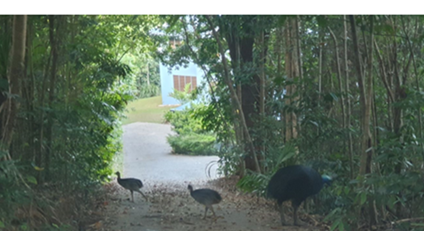
Father with two of its three chicks at Bingil Bay – Oct 2024
Background information and references
Cassowary numbers in FNQ
As of early 2026, scientific consensus provides a picture for both the broader region and specific hotspots.
The most widely accepted scientific figure for the entire Wet Tropics World Heritage Area (which includes the Cassowary Coast, Cairns, and the Daintree) is approximately 4,400 individuals. This estimate is based on large-scale DNA analysis of scats and feathers conducted by the CSIRO (led by Dr. David Wescott). While this number is higher than the "gloom and doom" estimates of the 1990s (which often cited only 1,200 birds), scientists warn that the population remains vulnerable and in "deterministic decline" in several sub-regions due to habitat fragmentation.
The Cassowary Coast Regional Council area (stretching from Innisfail down to Cardwell is (Specific Sub-Regions) is the heart of cassowary country. Population density varies:
- Mission Beach: Often cited as having the highest density of cassowaries in Australia. Intensive field surveys have identified approximately 110 to 150 individual birds in the immediate Mission Beach/Hinterland area.
- Kuranda/Barron Falls: Roughly 50–70 birds.
- Daintree/Lowland Rainforest: While further north, this area supports a significant portion of the remaining population, with density similar to the Cassowary Coast hinterland.
|
Cassowary Population trends 2006 |
|
|
Region |
Estimated Number (Adults/Sub-adults) |
|
Total Australian Population |
~4,500 – 5,000 |
|
Wet Tropics (FNQ) |
~4,400 |
|
Mission Beach Hotspot |
~110 – 150 |
|
Cape York Populations |
~500 – 1,000 (Very difficult to track) |
The Numbers of Breeding Adults
While the total population in the Mission Beach area (including sub-adults and chicks) is estimated at approximately 110–150 birds, the actual breeding core is much smaller:
- Total Breeding-Age Adults: Approximately 45–50 birds.
- The Gender Split: There is a significant "sex ratio" imbalance in Mission Beach. Surveys typically identify around 28 adult males and 19 adult females.
- The "Pair" Equivalent: If you were to define a "pair" as a successful mating event resulting in a nest, there are typically 20 to 25 active nests/broods in the Mission Beach area during a good season.
Size and weight
The Southern Cassowary is Australia’s heaviest bird and the third-largest bird in the world. Their size and weight change dramatically throughout their lifecycle, from a tiny striped hatchling to a massive, prehistoric-looking adult. Cassowaries reach full sexual maturity and adult weight at around 3 years of age.
Adult Cassowaries (Male vs. Female)
In the cassowary world, females are the dominant and larger sex. While they look similar, you can usually spot a female by her greater height, heavier build, and larger casque (helmet). An adult female cassowary can weigh as much as an average adult human. The largest recorded female southern cassowary weighed approximately 85kg.
|
Feature |
Adult Male |
Adult Female |
|
Height |
1.5m – 1.8m |
1.5m – 2m |
|
Weight |
35kg – 55kg |
60kg – 85kg |
The Chicks - go through several distinct "looks" before they get their glossy black feathers and blue necks.
The Hatchling (0–6 Months) - Weight at Birth: 300g – 500g. They are cream or tan with distinct longitudinal black stripes. This "watermelon" pattern helps them hide in the shadows of the forest floor. They grow incredibly fast. Within the first few weeks, they are already half the height of their father's leg. By one month old, they weigh around 750g.
The Juvenile (6–18 Months) - at about 6 months, their stripes fade, and they become a dull, fuzzy brown. By the end of their first year, they are often the same height as an adult (1.3m – 1.6m), though they are much thinner and haven't "filled out" yet. Usually they weigh between 20kg and 30kg during this stage.
A Keystone species
A keystone species is an organism that helps hold an entire ecosystem together. Without its presence, the ecosystem would be dramatically different or might collapse entirely. The term comes from the architectural "keystone" - the wedge-shaped stone at the very top of an arch. If you remove that one stone, the whole arch falls down, even though the other stones are still there.
A keystone species has a disproportionately large effect on its environment compared to its actual numbers. If you have 4,400 cassowaries in a massive rainforest, that isn't a lot of birds, but their "job" is so specialized that no other animal can do it.
There are three main types of keystone species:
- The Predator: They keep other populations in check. (Example: Wolves in Yellowstone keep elk from overgrazing).
- The Engineer: They physically create or move the environment. (Example: Beavers building dams that create wetlands for hundreds of other species).
- The Gardener (The Mutualist): They provide a vital service like pollination or seed dispersal. This is where the Southern Cassowary fits.
The Cassowary is the "Gardener of the Rainforest"
In Far North Queensland, the cassowary is the ultimate keystone species for one specific reason: Seed Dispersal. Many rainforest trees (like the Ryparosa or the Cassowary Plum) produce fruits that are too large, too hard, or too toxic for other birds and animals to eat. But the cassowary has a large, gentle digestive tract. It swallows these fruits whole, digests the flesh, and "deposits" the seeds in a big pile of natural fertilizer (scat) far away from the parent tree.
The Result is that over 150 species of rainforest plants depend almost entirely on the cassowary. If the cassowary went extinct, those trees would stop spreading, the forest would thin out, and all the insects, frogs, and birds that live in those specific trees would lose their homes.
The "Trophic Cascade"
When a keystone species is removed, it triggers a trophic cascade which is a "domino effect" of local extinctions. In Mission Beach, if the "Super Dads" stopped raising chicks, the rainforest would eventually be replaced by faster-growing, smaller-seeded "weed" trees, fundamentally changing the landscape forever.
Other Famous Keystone Species: Sea Otters, African Elephants, and Great Barrier Reef Sharks who keep the mid-level predator populations in check, which protects the smaller fish that clean the coral.
References
Cassowary Rearing & Local Sightings
C4 (Community for Coastal and Cassowary Conservation): Official Website & Newsletters.
Wet Tropics Management Authority: Cassowary Rearing Biology. Scientific details on the male-only incubation and rearing process.
Dr. Joan Bentrupperbäumer: Population Ecology of the Southern Cassowary (2007). This academic study provides the baseline for chick survival rates and historical clutch sizes in Mission Beach.
The World Economic Forum www.weforum.org
What are keystone species, and why do they matter?
Pilanesberg National Park & Game Reserve www.pilanesbergnationalpark.org
The terrifying truth of losing our keystone species - Conservation
Arizona State University - askabiologist.asu.edu
What is a Keystone? | Ask A Biologist
Qld Government Be cass-0-wary safety tips https://www.qld.gov.au/environment/plants-animals/animals/living-with/cassowary-safety-tips